
Candidates
Non-compete clauses are on borrowed time: what the Govt's crackdown means for engineering employers and candidates
By Talentometry15 Oct 20263 min read
Non-compete clauses in UK employment contracts are set to be curbed by law. Speaking at the Innovation Nation Summit in Manchester on 9 October, Prime Minister Andy Burnham confirmed the Government will legislate to stop non-competes acting as a barrier to hiring.
Dubbing it a "Bosman ruling for the innovation sector", the move aims to help start-ups and scaling firms compete for talent and marks one of the biggest shifts in UK employment practice in years.
Here is a quick breakdown of what was announced, how it affects the engineering sector, and what employers and candidates should do next.
4 Things You Need to Know About the Announcement
While the speech was light on legislative detail, four key points stood out:
- It goes beyond tech start-ups: Burnham indicated the reforms will also cover workers in the wider "everyday economy" meaning OEMs, systems integrators, and contractors are in scope alongside robotics and AI scale-ups.
- Notice periods are next: The Government plans to look at wider restrictive practices, specifically targeting long notice periods and garden leave to stop employers simply shifting how they lock staff in.
- The detail lands on 28 October 2026: Concrete proposals, a formal consultation, and a legislative timetable are expected alongside the Autumn Budget.
- Nothing has changed yet: Any change requires an Act of Parliament and is unlikely to take effect before 2027. Existing clauses remain enforceable if they are reasonable.
What Options Are on the Table? Around 5 million British workers have a non-compete in their contract. Although many wouldn't hold up in court, the high cost of a High Court challenge means most people comply anyway.
Based on the Government’s November 2025 working paper, the upcoming proposals on 28 October will likely follow one of five routes:
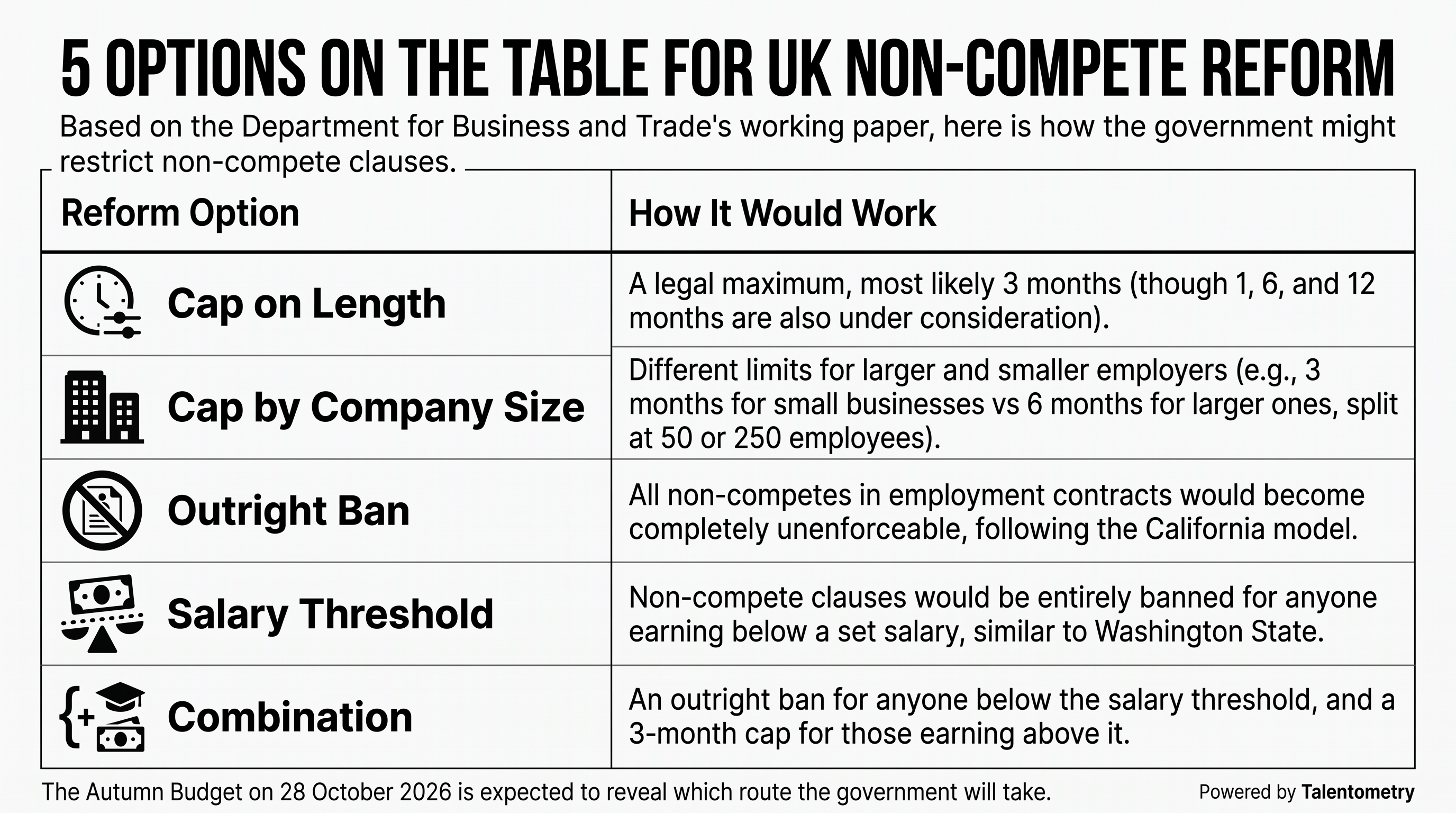
What This Means for Controls, Automation, Robotics & M&E The talent pool for experienced controls, robotics, and M&E engineers is notoriously tight. Right now, a strong candidate’s move to a direct competitor can easily stall over a restrictive covenant. Looser rules will widen the hiring pool and make it much easier for specialists to move jobs or strike out on their own.
In our sectors, the impact will be felt most acutely in three areas:
Client-facing engineers at systems integrators: Controls and automation engineers build deep relationships on end-user sites. For them, client non-dealing and non-solicitation clauses often matter more than a straight non-compete. Keep a close eye on whether the Autumn Budget reforms stretch to cover these too.
Sales, BD, and Account Managers: Carrying pricing knowledge and client accounts, these roles face the tightest restrictions and stand to gain the most mobility from a cap or ban.
Senior engineers, PMs, and Department Heads: Three-to-six-month notice periods are standard at this level. If the Government caps notice periods alongside non-competes, start dates will shorten across the board—which helps when you are hiring, but hurts when you are losing key people.
What Should You Do Now? The short answer for both sides: don’t act on the headline, but prepare for the detail.
If you’re an employer:
- Keep your current clauses for now: The law hasn’t changed yet. Continue using reasonable, well-targeted covenants where genuinely needed.
- Audit your contracts: Check who actually has a non-compete and whether it’s realistic. A blanket 12-month restriction on a junior engineer isn't enforceable today anyway.
- Tighten your IP and confidentiality terms: If non-competes are weakened, robust intellectual property and confidentiality clauses will become your primary defence.
- Focus on retention: If you can no longer rely on a contract to stop a rival integrator or contractor poaching your best engineers, keeping them comes down to pay, progression, project quality, and culture.
If you’re a candidate:
- Check your contract before interviewing: Know your exact notice period, non-compete terms, and any client non-dealing restrictions before you go to market.
- Assume your restrictions still apply: A speech doesn't void your contract. Always take proper legal advice before making a move that could breach your terms.
- Tell your recruiter early: Being upfront about your restrictions means we can factor them into the roles we approach for you and how we negotiate your start date.
Talk to Us
We’ll update this post once the full proposals land alongside the Autumn Budget on 28 October.
In the meantime, Talentometry recruits across controls, automation, robotics, and M&E. Whether you're an employer looking at how restrictions affect your hiring shortlist, or an engineer weighing up your next move, get in touch with our team today.
Looking for your next role?
See every live role, updated as soon as we post it.